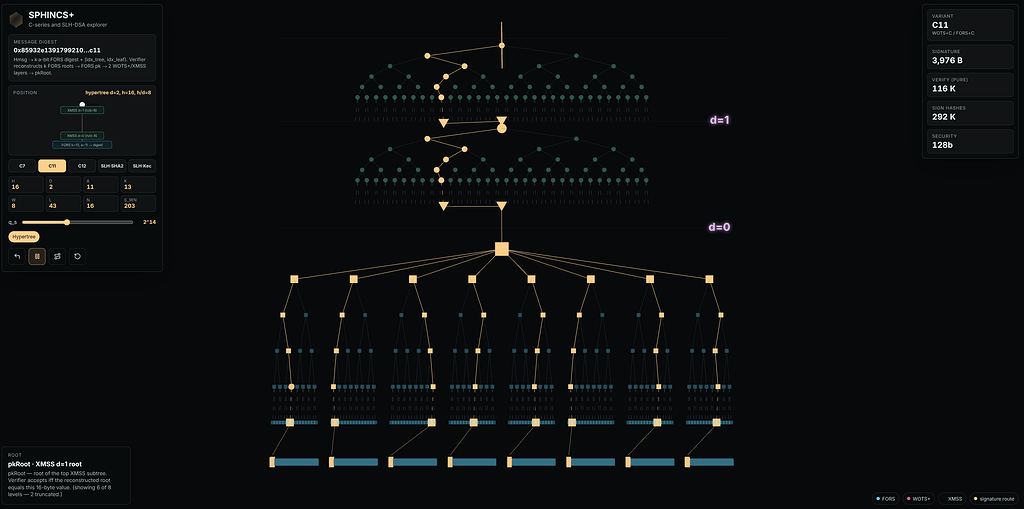
colinlyguo submitted EIP-8298 SETCODEFROM, which follows Ben Adams' idea from an ACDE call to combine the goals of EIP-7851 and EIP-8058 into a lower level code adoption primitive: the current account can adopt the code of an already deployed contract. SPHINCS minus on ethresear.ch describes efficient verification of stateless post-quantum signatures on the EVM. EIP-7904 was converted to Informational, since clients already reach the 100 Mgas/s target at current gas costs and no compute repricing is needed. Erigon joined the Encrypt the Mempool Coalition.
(colinlyguo), submitted, with a Magicians thread at 22:10; this is EIP-8298. It comes from benaadams' idea on an ACDE call to combine the goals of EIP-7851 and EIP-8058: a new EVM instruction lets the current account adopt the code hash of an existing deployed contract. The source is a live account address rather than a raw code hash, so the adopted code is tied to the current consensus state. There are two main uses. First, deployment cost (the problem EIP-8058 targets): contracts with identical runtime code initialize their own storage and then adopt shared code without paying code deposit gas again for bytecode clients already store, which matters more once EIP-8037 makes deployment more expensive. Second, EOA migration with ECDSA authority disabled (the problem EIP-7851 targets): migration code initializes wallet state, including post-quantum wallet state, then adopts regular wallet code; once the account has regular code, ECDSA transaction origination is disabled under EIP-3607 and EIP-7702 redelegation through the old ECDSA key is no longer available.
New EIP: SETCODEFROM Code Reuse Instruction (colinlyguo), submitted, with a Magicians thread at 22:10; this is EIP-8298. It comes from benaadams' idea on an ACDE call to combine the goals of EIP-7851 and EIP-8058: a new EVM instruction lets the current account adopt the code hash of an existing deployed contract. The source is a live account address rather than a raw code hash, so the adopted code is tied to the current consensus state. There are two main uses. First, deployment cost (the problem EIP-8058 targets): contracts with identical runtime code initialize their own storage and then adopt shared code without paying code deposit gas again for bytecode clients already store, which matters more once EIP-8037 makes deployment more expensive. Second, EOA migration with ECDSA authority disabled (the problem EIP-7851 targets): migration code initializes wallet state, including post-quantum wallet state, then adopts regular wallet code; once the account has regular code, ECDSA transaction origination is disabled under EIP-3607 and EIP-7702 redelegation through the old ECDSA key is no longer available.
20:15 (nicocsgy), with thanks to Vitalik, Justin Drake, the EF PQ and cryptography team and others. Starting from the fact that quantum computers will eventually break ECDSA, it discusses how stateless hash-based signatures can be verified on the EVM at acceptable cost.
(misilva73), merged. The gas analysis was rerun with the EIP-7928 (BAL) optimizations stabilized; at the 100 Mgas/s target, every examined compute operation and precompile clears the target at its current gas cost. The EIP is retitled "Compute Gas Cost Analysis".