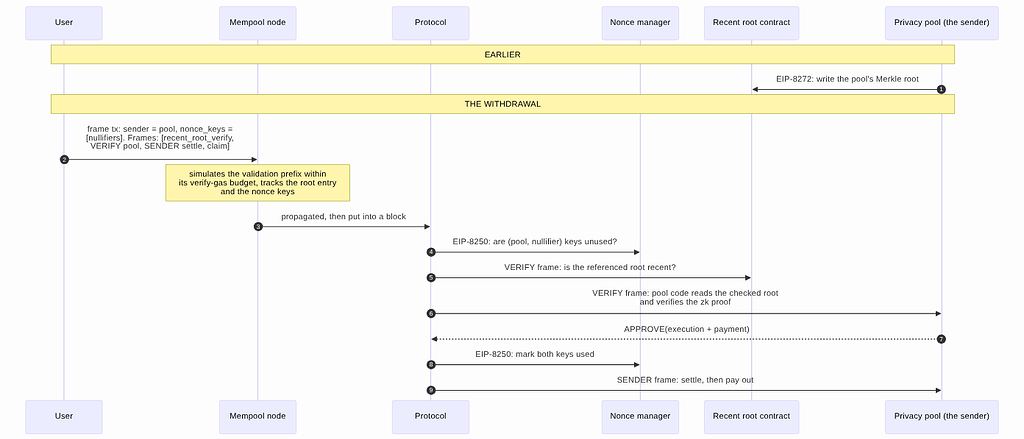
The EF published a list of 8 contract invariants that EIP-8037 and EIP-8038 will break, along with a self-check repository, and the Glamsterdam fork on Hoodi will not be scheduled until this is resolved. Nethermind ran a privacy pool that pays its own gas on frame transactions; a withdrawal costs about 679k gas, but proof verification exceeds the validation gas limit. The EF also explained transaction assertions, a Hegotá candidate, and the Partitioned Binary Tree state migration planned for I*.
Published under Marius van der Wijden's name. During Glamsterdam testing, ChainSecurity found that invariants some projects rely on will be broken by EIP-8037 (higher state creation cost) and EIP-8038 (repriced state access), because both change how certain operations and state are charged. ACD has therefore paused the hard fork process and will not fork Hoodi until this is resolved. Hegotá work is unaffected and continues at full speed in parallel.
The EF is working with two audit firms, ChainSecurity and Dedaub, and running internal audits, but cannot cover every project, so it issued a call to action: the glamsterdam-gas-invariants self-check repository explains each invariant with examples and prompts you can use directly to check a project. If you are affected, contact glamsterdam@ethereum.org.
Posted at 20:00 by Daniil Ankushin of Nethermind, with measurements by Manuel Arto. On frame transactions the privacy pool pays its own gas, so private withdrawals need no relayer. They ran a real BN254 Groth16 pool (soispoke's minimal-shielded-pool) on current Nethermind master: one withdrawal costs 679,322 gas. During a withdrawal the pool contract is the sender, its VERIFY code checks the zk proof and approves execution and payment, and the user needs no funded account and does not appear in the transaction. With EIP-8250 keyed nonces, several withdrawals can run concurrently from the same pool address.
06:04. User interviews keep coming back to people not being sure what they are signing. With assertions, the wallet shows the exact effect, and the transaction either does what was expected or reverts in full. Background: EF Blog: how native transaction assertions enforce a transaction's final outcome (2026-10-05).
EF: if assertions ship with Hegotá, users can sign with more confidence, 06:04. User interviews keep coming back to people not being sure what they are signing. With assertions, the wallet shows the exact effect, and the transaction either does what was expected or reverts in full. Background: EF Blog: how native transaction assertions enforce a transaction's final outcome (2026-10-05).
08:05. A Partitioned Binary Tree (PBT) shrinks state proofs so that wallets can verify instead of trusting, and paves the way for state expiry. EIPs PR #12633: EIP-8347 specifies readiness at activation and late migration, opened at 16:58, covering nodes whose PBT is not ready when the activation block arrives (they should return SYNCING rather than mark the block invalid).
EF: I* plans to rebuild the state structure without downtime, 08:05. A Partitioned Binary Tree (PBT) shrinks state proofs so that wallets can verify instead of trusting, and paves the way for state expiry. EIPs PR #12633: EIP-8347 specifies readiness at activation and late migration, opened at 16:58, covering nodes whose PBT is not ready when the activation block arrives (they should return SYNCING rather than mark the block invalid).
19:32: Justin Drake's post-quantum and post-AI transition targets December 2028; two Solidity compilers, Solar v0.3 and Slang alpha. The newsletter cites an average gas price of 0.2 gwei this week from ultrasound.money.